Introduction
In recent years, face masks have evolved from a somewhat frumpy treatment performed behind spa doors to a regular part of trendsetter beauty routines. Celebrities post Instagram selfies wearing a sheet mask, and the skincare industry is catching up with this trend, offering a growing variety of products that provide manifold desirable effects. In Asia, many K-Beauty and Japanese beauty products regularly include face masks as an inherent part of the daily beauty treatment. This trend is now rapidly catching on in other regions of the world. Both men and women are looking for mask treatments that leave the skin soft and radiant. Face masks can provide moisture, reduce acne, refresh, and even whiten, depending on their ingredients.
One important feature that unites all face masks is ease of use and an agreeable skin feeling. This is achieved by the addition of a thickener. The choice of the thickener depends on factors such as purity, colour and smell, as well as on its rheology profile. Increasingly, customers also expect their products to fulfil other criteria, including natural formulations, Non-GMO raw materials, ethical, and animal-friendly status.
With its ideal rheology profile, xanthan gum is the thickener of choice for face masks. This fact sheet explains why.
Rinse-off versus sheet mask
Face masks can be separated into two categories: the traditional rinse-off mask as emulsion, gel or suspension with direct application onto the skin, and the new trendy sheet mask. Sheet masks usually consist of a cotton sheet soaked with a liquid phase containing a concentrated serum with active ingredients. The sheet prevents quick evaporation of the water phase and thus extends the penetration time. Due to its functional design the sheet mask acts as an incubator, holding and protecting active ingredients. Its high water content gives it an intense cooling effect. Besides being convenient and simple to use, sheet masks also have soothing, calming, and moisturising properties that replenish damaged and dehydrated skin.
Thickeners in cosmetics and toiletries
Xanthan gum is an exceptional rheology control agent that is very effective even at low concentrations. It provides different flow properties depending on concentration and co-solutes, allowing the texture and rheology of any product to be tuned and controlled to meet specific needs. Xanthan gum is a viscoelastic material which can behave more like an elastic solid or more like a viscous fluid, depending on the concentration. It possesses pseudoplasticity, meaning viscosity decreases with increasing external stress, and provides a yield stress controlling stability and resistance to flow.
Water retention is an important feature in sheet masks to prevent drying and to ensure a refreshing sensation during use. With its high water retaining capacity, xanthan gum ensures optimum moisture retention for a long-lasting fresh skin sensation.
Apart from its rheological and water-binding benefits, xanthan gum has the advantage of being of natural origin, tasteless and odourless, allergen- and GMO-free, and is approved as ingredient of natural origin according to Ecocert COSMOS standards. What’s more, Jungbunzlauer can supply xanthan gum as a clear solution that is, for the first time, fully vegan.
Thus, xanthan gum has all the qualities needed to make it the perfect thickening agent for face masks.
Xanthan Gum with optimised rheology and controllable texture
Whether it’s designed for a sheet mask or a rinse-off mask, formulations should always be stable, with no tendency to phase separation. They should be easy to apply and ensure sufficient adhesion to the skin during treatment. Xanthan gum with its controllable rheological properties easily helps fulfil these requirements. Depending on concentration, salt content, and xanthan type the flow behaviour of xanthan gum can be tuned to meet the desired criteria. Figure 1, for example, shows the different viscosity and flow curves of two Jungbunzlauer xanthan gum types for personal care applications (XG FNCS PC, a clear solution xanthan gum type with normal viscosity, and XG FNCSP PC, a clear solution xanthan gum type with reduced pseudoplasticity) given different xanthan concentrations and solvent conditions. The xanthan systems shown (xanthan type/concentration/salt content) are examples of systems with extremely high or extremely low viscosity and shear stress profiles and are suitable for face mask applications. They demonstrate how stability, skin adhesion and spreadability can be varied depending on the desired rheology properties of the final product.
Apparent shear viscosity is measured by variation of the rotational shear rate, providing information about the dispersion’s stability under changing external stress. Changes in viscosity at varying shear rates influence overall product stability and performance.
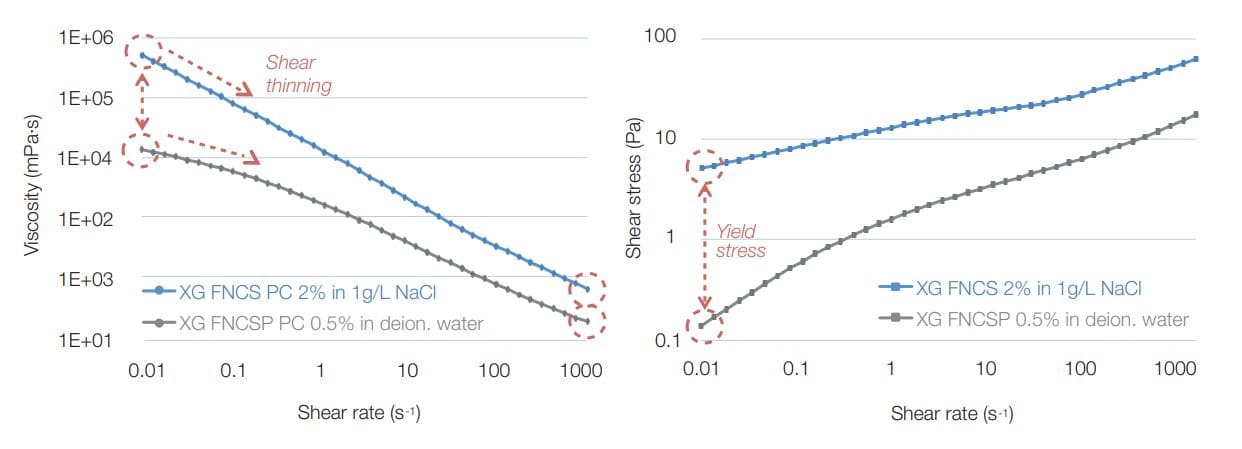
Figure 1: Viscosity (left) and flow (right) curves of XG FNCS PC (2.0% xanthan concentration in sodium chloride solution) as upper limit and XG FNCSP PC (0.5% xanthan concentration in deionised water) as lower limit.
Analysing the behaviour of the solutions at very low shear rates, which represent conditions during storage, enables evaluation of the stabilising effects. Increasing the shear rate allows the analysis of behaviour under increasing forces as experienced during treatment, spreading or even spraying.
Highly concentrated XG FNCS PC in a slightly salty solvent shows much higher viscosity values at very low shear rates and thus demonstrates very strong stabilising properties. Consequently, the higher yield stress supports excellent adhesion on the skin. This highly viscous xanthan system provides a much greater resistance to flow and avoids undesirable dripping when applied to the face. It also possesses a higher shear thinning power compared to XG FNCSP PC. Thus it is still easy to spread FNCS PC on the skin – a desirable feature for rinse-off masks – despite its greater viscosity.
The XG FNCS PC system therefore exhibits the best rheological properties for face mask applications.
Besides high stability and skin adhesion, a face mask should also provide a pleasant skin feeling and smooth texture without being sticky or tacky. Here again xanthan gum offers perfect conditions due to its controllable texture profiles. The ideal tool for predicting skin feeling is a texture analyser, which provides numeric, reproducible, and comparable results. Figure 2 shows the texture profiles generated by a texture analyser using the rheological data presented in Figure 1.
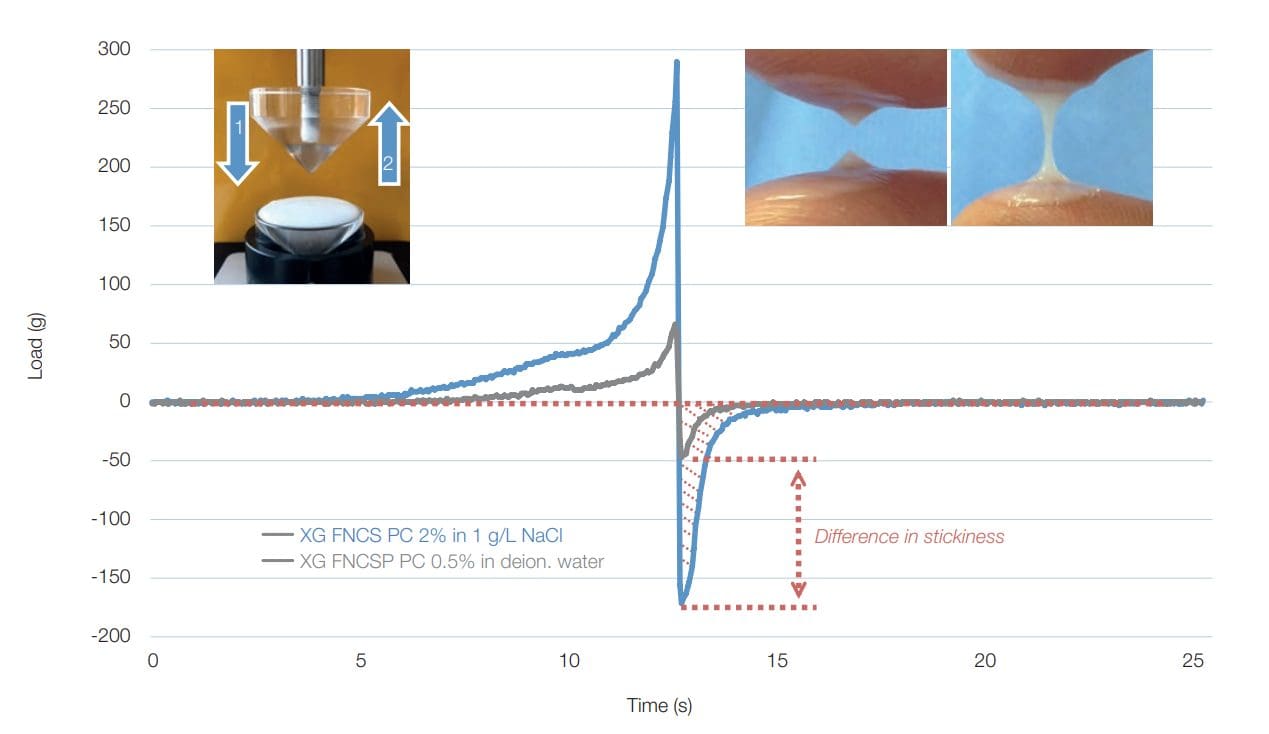
Figure 2: Texture profiles of XG FNCS PC (2.0% xanthan concentration in sodium chloride solution) as an example of a high viscosity profile and XG FNCSP PC (0.5% xanthan concentration in deionised water) as an example of low viscosity. The demonstration cone penetrates the sample and returns to the starting point.
During this test method a conical stamp penetrates the sample while the force used to penetrate the sample constantly increases. When the specified penetration distance has been reached, the cone withdraws from the sample and returns to its starting position, and the restraining forces are measured.
The higher negative force of the XG FNCS PC system, as measured when the cone returns to its starting position, indicates a more sticky skin feeling. Thus the texture of the FNCSP PC sample would give a smoother skin feel to face masks.
Both a gel-like rinse-off mask with a rich texture and a light, smooth liquid phase for a sheet mask can be easily produced, depending on the intended purpose of the formulation. With the right choice of xanthan concentration and solvent, the different Jungbunzlauer xanthan types help adjust and control the rheological and textural properties of a specific cosmetic product and offer great flexibility. This flexibility means that xanthan gum can simplify the decision as to the best choice of thickening agent from the broad spectrum available.
In view of the above findings, XG FNCS PC was considered the best choice for thickening face masks because of its rheological advantages, such as better stabilisation and more pseudoplasticity.
Based on these results, we developed a formulation for an active phase for sheet masks:
| Phase | Ingredient | Supplier | Quantity wt% |
| A | Water, deionized | qs to 100 | |
| XG FNCS PC | Jungbunzlauer | 1.0 | |
| ERYLITE® | Jungbunzlauer | 3.0 | |
| B | D-Panthenol 75% | 1.3 | |
| Actipone® Pomegranate GW | Symrise | 0.5 | |
| Actipone® Green Papaya GW CL | 0.8 | ||
| Extrapone® Cucumber | 0.5 | ||
| Hyaluronic Acid | 0.1 | ||
| C | Perfume | qs | |
| Preservative | qs |
Besides Jungbunzlauer’s XG FNCS PC as thickening and stabilising agent, the formulation features ERYLITE® as moisturiser and panthenol as a soothing agent. Different fruit extracts have been added, such as pomegranate to stimulate and as an antioxidant, papaya as a brightening agent and cucumber to refresh the skin. A small amount of hyaluronic acid acts as an extra humectant.
By simply increasing the xanthan gum concentration to 3%, a gel-like rinse-off mask can be achieved. Due to its very high stability and skin adhesion this can be used without the sheet base.
Xanthan Gum versus synthetic thickening agents
To evaluate the performance of xanthan gum as a natural thickening agent in these sheet masks, the presented formulation was compared to commercially available products. Three different sheet masks containing xanthan gum in combination with different synthetic or semi-synthetic thickeners were tested with regard to flow behaviour and texture profiles (Figure 3):
| Product | Thickening agent |
| Product 1 | Xanthan Gum, Hydroxyethylcellulose, Hydroxyethyl Acrylate/Sodium Acryloyldimethyl Taurate Copolymer, Carbomer |
| Product 2 | Xanthan Gum, Hydroxyethyl Acrylate/Sodium Acryloyldimethyl Taurate Copolymer |
| Product 3 | Glyceryl acrylate/Acrylic acid Copolymer, Xanthan Gum |
The correlation of flow behaviour and texture in Figure 4 shows the advantages of using pure xanthan gum as thickening agent for the liquid phase of a sheet mask. Compared to the commercial products, the formulation with xanthan gum exhibited the highest viscosity value at very low shear rates, and hence the best dispersion stabilising effects. Consequently, it shows the highest yield stress and provides the highest resistance to flow. This means that during the sheet mask treatment the formulation thickened with xanthan gum enabled the best skin adhesion with no tendency to drain or slip.
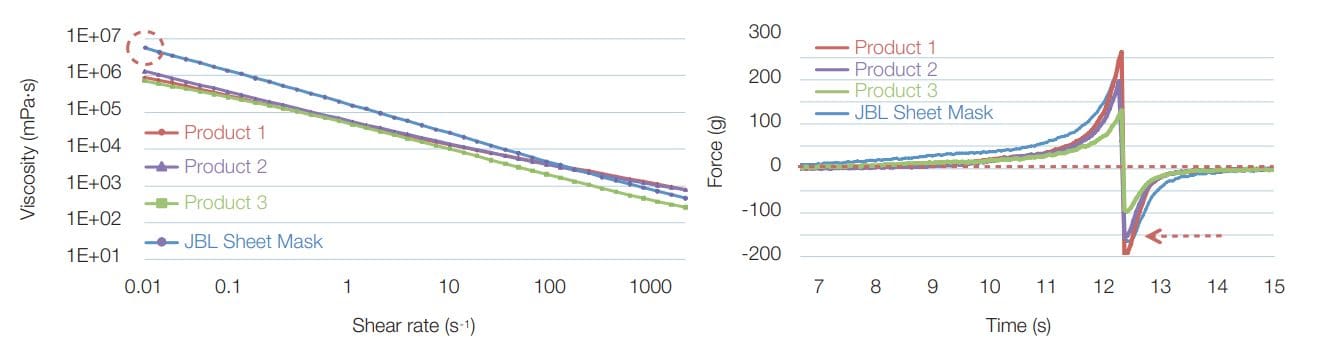
Figure 4: Viscosity curve (left) and texture profiles (right) of the liquid phase developed by Jungbunzlauer, compared to three commercially available products.
An indication of the cohesiveness and stickiness of the different products is given by the negative part of the texture profiles (red arrow).[3] The maximum negative force measures the sample’s adhesive force and correlates to the stickiness of the product. Despite the high viscosity at low shear rates, the formulation with xanthan gum shown here offers a good relation between product stabilisation and smooth skin feeling.
Conclusion
Xanthan gum shows exceptional performance in cosmetic applications such as face masks. Several tests showed that Jungbunzlauer’s XG FNCS PC is highly suitable for face mask applications in terms of stability, flow behaviour and texture. Based on these results a formulation was developed that can be adapted for use in sheet face masks as well as traditional rinse-off face masks. The formulation with xanthan gum alone as the natural thickener exhibits superior stabilisation performance compared to commercially available sheet masks containing several thickeners, including synthetic and semi-synthetic types, while still maintaining an agreeable skin feeling.
Xanthan gum fulfils the required rheological and texture requirements, and with the added benefit of being natural, it is the perfect choice for a face mask thickener.
References
[1] A. Patil and M.S. Ferritto, Polymers for personal care and cosmetics: Overview, ACS Symposium Series 2013,1148, 3-11.
[2] D. Laba, How do I thicken my cosmetic formula? Cosmetics & Toiletries, 2011.
[3] http://www.brookfieldengineering.com/applications/personal-care-products/moisturizing-cream-spreadability
** The information contained herein has been compiled carefully to the best of our knowledge. We do not accept any responsibility or liability for the information given in respect to the described product. Full and sole responsibility for use of our products lies with the user, especially in respect to third-party patent rights and to laws or government regulations.
© 2017-182 Jungbunzlauer Suisse AG
Interested in developing your next face mask formulation?
Our technical experts support customers in translating scientific insights into effective product applications.
If you’d like guidance, data, or formulation support, we’re here to help.
Learn more about uses, formulations, and support offered in our guide: What is xanthan gum?