
Introduction
Proteins are added to a variety of beverages for functional and nutritional reasons. High-protein sports drinks in particular form a considerable part of the growing functional foods market. Owing to their ease of consumption and nutritional value, they are a convenient product particularly during and after workouts.
Bodybuilders and athletes, focused on muscle growth, endurance and strength, are the traditional consumers of protein drinks. With the evolving fitness trend, lifestyle and occasional consumers are now also interested in these products. In addition to a well-balanced nutritional profile, a pleasant taste is essential for these consumers. Clear acidic protein drinks in particular, also known as protein waters, constitute an appealing, refreshing and thirst-quenching high-protein alternative, gaining in popularity over protein shakes. And of increasing appeal are sport drinks with added vitamins and minerals that can provide specific health benefits [1].
Whey proteins are the preferred protein source for sports drinks due to their high nutritional quality and easy digestion. Fortified drinks usually contain between 3 and 7% protein and they are further classified according to their pH value. Neutral pH beverages (pH 4.6–7.5) are typically shakes with creamy flavours such as chocolate and vanilla. Acidic beverages (pH 2.8–3.5) have a clear and more refreshing appearance and fruity flavours [2].
Whey proteins are manufactured from sweet whey, the liquid fraction of milk that remains after casein and fat removal during the manufacture of cheese. Further filtration, concentration and drying obtains whey protein concentrate (WPC), isolate (WPI) and hydrolysates. WPI is the first choice for clear protein waters, with its high protein, low fat and low lactose content [3]. However, protein waters fortified with whey protein often exhibit formulation challenges and the following
article offers solutions to these challenges.
Table 1: Commercially available whey protein products[3]
| Protein | Common application | |
| Whey protein concentrate | 25–89% | Beverages, bars, confectionery, baked goods, infant formula |
| Whey protein isolate | > 90% | Beverages, bars, high-quality products |
| Whey protein hydrolysate | 80–90% | Infant formula, sports and medical nutrition |

Challenges presented by protein waters
Sensory challenges
Whey proteins are known to exhibit undesirable off-tastes arising mainly from lipid and protein oxidation during processing and storage. Protein suppliers have made great efforts to improve processing conditions of whey products. Nevertheless, products containing whey protein are often associated with sweet aromatic, cooked milk, bitter or soapy attributes. In addition, acidic whey protein beverages tend to exhibit an astringent mouthfeel [4]. In general, such off-tastes hinder consumer acceptance and product developers are seeking solutions to overcome these challenges.
Acid selection
Whey proteins have to remain soluble to ensure the clarity of the protein water. They are most soluble at pH values above or below their isoelectric point and a pH of between 2.0 and 3.5 should therefore be targeted. Many protein waters on the market contain phosphoric acid which has a neutral taste with little impact on overall flavour. Ongoing regulatory scrutiny and a consumer desire for natural products mean that consumers are more and more unwilling to accept phosphoric acid and suppliers are seeking alternatives. In addition to its functionality, acid selection has a great impact on taste and acid type has also been shown to correlate with the astringency of protein waters[2].
Mineral fortification
Protein waters usually contain as few ingredients as necessary to avoid cloudiness and assure stability. Mineral fortification is a particularly sensitive issue in recipe development due to the related buffering effect and stability problems. However, consumers expect certain functionalities and nutritional value when consuming protein beverages, making mineral fortification attractive to product developers.
This paper shares comprehensive solutions for protein waters offered by Jungbunzlauer – off-taste masking, natural acids for acidification, and calcium and magnesium salts for mineral fortification.
Taste improvement with ERYLITE®
ERYLITE® is a fermentation-based polyol that is permitted in energy-reduced flavoured drinks or those with no added sugar up to a maximum concentration of 1.6% (w/w) in the European Union and 3.5% (w/w) in the United States and Canada, respectively. From a physiological point of view, it is a very interesting additive as it has a high digestive tolerance, zero caloric value and zero glycaemic index.
As shown in several Jungbunzlauer publications, ERYLITE® is known to be a highly effective flavour enhancer. For instance, it has been shown that ERYLITE® significantly improves the taste of sweeteners based on steviol glycosides, specifically eliminating the lingering effect of stevia[5].
As mentioned above, protein waters often tend to exhibit a strong whey protein taste and astringent mouthfeel, resulting in a less pleasant drinking experience. Consequently, the objective of the following sensory study was to investigate the influence of ERYLITE® on the overall taste of protein waters.
Experimental setup
A discrimination test (triangle test) was conducted, being a useful method of determining whether there is a significant difference between two products.
Two hibiscus-ginger flavoured protein waters with 5% WPI were prepared, one of which contained 1.6% ERYLITE®, as shown in Table 2. Both recipes were presented to a trained sensory panel. They were served at room temperature (21 °C) in three-digit-coded beakers in a fully-balanced randomised presentation design. Three samples, two of them identical, were presented to the panellists who were asked to identify the deviating sample. They were also asked to comment on the difference detected. Data collection and statistical evaluation of the results were performed using FIZZ web software.
Table 2: Protein water recipes for sensorial evaluation
| Ingredients | Supplier | Recipe 1 (standard) [%] | Recipe 2 (with ERYLITE®) [%] |
| Water | 94.28 | 92.68 | |
| Whey protein isolate (probevTM) | Milk Specialties | 5.00 | 5.00 |
| ERYLITE® | Jungbunzlauer | – | 1.60 |
| Gluconic Acid (50%) | Jungbunzlauer | 0.25 | 0.25 |
| Hibiscus extract | Wild | 0.20 | 0.20 |
| Citric Acid | Jungbunzlauer | 0.15 | 0.15 |
| Ginger flavour | Döhler | 0.10 | 0.10 |
| Sucralose | Tate & Lyle | 0.02 | 0.02 |
| Total | 100.00 | 100.00 |
Preparation:
Whey protein isolate was dissolved in 80% of the water at room temperature with constant but gentle stirring. Once all the protein was dissolved properly, sucralose, ERYLITE® (recipe 2 only), hibiscus extract and flavour were added and stirred well. The pH was then adjusted to 3.2 with citric acid and gluconic acid. After adding the rest of the water, the beverage was heated to 70 °C for 15 s and hot filled into bottles.
Results
Panellists were able to detect a significant difference in taste between the samples. More precisely, the protein water without ERYLITE® was described as less sweet but slightly more acidic. This is an unsurprising effect as the additional sweetness comes from the 1.6% ERYLITE®. Additionally, the protein water with added ERYLITE® was characterised as more aromatic and more full-bodied compared with the beverage without ERYLITE®, which was rated as slightly plainer in taste. There was also a tendency for ERYLITE® to mask whey protein off-tastes.
These results can be explained by the taste improvement properties of ERYLITE®. Sucralose is a high-intensity sweetener and lacks the ability to provide body and mouthfeel to the protein water. ERYLITE® is a bulking agent and provides substantial mouthfeel without adding calories to the recipe. Consequently, a combination of high-intensity sweetener and ERYLITE® is recommended.
Based on these results, the addition of 1.6% ERYLITE® can improve the overall taste of protein waters containing whey protein isolate by promoting flavour and sweetness and by reducing off-tastes.

Phosphoric acid replacement
In contrast to phosphoric acid, which is produced by chemical processing, all Jungbunzlauer acids are fermentation-based. This is an obvious advantage when it comes to consumer desire for more natural ingredients. The following experiment investigated the influence of citric acid, lactic acid and gluconic acid on acidity and overall taste of a protein water containing 5% WPI and performed a comparison with phosphoric acid.
Experimental setup
As in Table 2, a hibiscus-ginger flavoured protein water with ERYLITE® was prepared without any acid. The individual preparations were then adjusted to pH 3.2 using either phosphoric acid or the organic acids summarised in Table 3.
Table 3: Acids tested in protein water
| Acid | Code | Active substance [%] | |
| Phosphoric Acid | PA | 85 | Liquid |
| Citric Acid | CA | 100 | Solid |
| Lactic Acid | LA | 90 | Liquid |
| Gluconic Acid | GA | 50 | Liquid |
| Citric Acid/Lactic Acid | CALA | 50/50 | Solid/liquid |
| Lactic Acid/Gluconic Acid | LAGA | 50/50 | Liquid/liquid |
| Citric Acid/Gluconic Acid | CAGA | 50/50 | Liquid/liquid |
Results
Both protein waters made with pure organic acids and organic acid blends were as clear as protein waters made with phosphoric acid. Depending on the initial pH of the whey protein isolate, which is affected by processing, larger quantities of organic acids are necessary to achieve a target pH of 3.2 due to their lower acid strength.
With regard to taste, the citric acid/gluconic acid (50:50) blend performed very well along with the hibiscus-ginger flavour. Compared to the protein water with phosphoric acid, it was slightly more sour, resulting in a more balanced acid-sweetness profile. In addition, it was perceived as fruitier, more lively and more refreshing.
Since citric acid provides a tart and sharp sourness that dissipates quickly, it promotes the refreshing nature of the protein water. Additionally, hibiscus extract utilised as a colourant and flavour naturally contains citric acid[6]. In contrast, gluconic acid has only approximately one-third of the sourness of citric acid but exhibits a long-lasting and mild taste profile that complements citric acid favourably.
Depending on the flavour and source of protein (e.g. plant based proteins), other acid blends such as citric acid/lactic
acid would also appear to merit further research.
Mineral fortification with calcium and magnesium
Calcium and magnesium rank among the most abundant minerals in the human body. Their main functions and approved daily recommended intakes are summarised in Table 4. In general, organic mineral sources show better bioavailability, higher solubility and better organoleptic qualities than inorganic mineral salts. Therefore, they are first choice for the fortification of functional beverages.
In this study, the performance of Jungbunzlauer’s fermentation-based calcium lactate gluconate (CLG) and magnesium lactate (ML) was evaluated in a protein water matrix.
Figure 4: Combing forces measured after leave-in hair conditioner treatment
| Mineral | %RDI* [mg/day] | %DV** [mg/day] | Functions in human body/claims |
| Calcium | 800 | 1300 | Constitution of bones and teeth. Secondary messenger for signal transmission. Blood coagulation Muscle function |
| Magnesium | 375 | 420 | Enzymatic reactions Secondary messenger immune system Constitution of skeletal muscles Stability of bones |
Experimental setup
A protein water without minerals was prepared according to instructions in Table 2 (recipe 2) and subsequently compared with a protein water fortified with 0.19% CLG and 0.07% ML, constituting 10% DV in the US and 2% RDI in the EU. For the mineral-fortified recipe, minerals were pre-dissolved in 20% of the water and then added to the protein solution after pH adjustment.
Results
The minerals incorporated were completely soluble in the protein water. The slight increase in pH, arising from the buffering effect of the minerals, did not result in turbidity of the protein water. The addition of 10% DV magnesium and calcium would therefore appear to be a good compromise between adequate mineral fortification and clarity without additional pH adjustment. With regard to taste, the addition of CLG and ML had no significant effect.
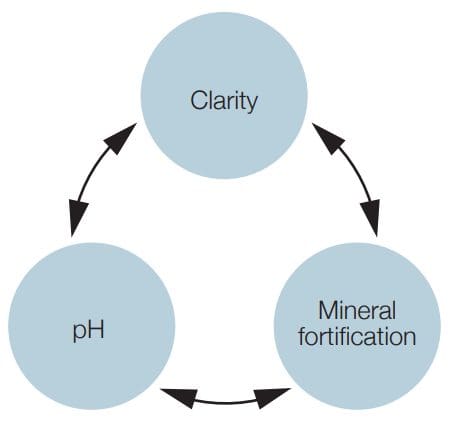
However, depending on the initial pH of the whey protein isolate and the amount of acid present in the recipe, a further adjustment of the pH might be necessary to guarantee high clarity of the protein water for the duration of its shelf life. The same applies if higher amounts of minerals are added because the balance between mineral fortification, pH and clarity of the drink should always be kept in mind.
Figure 1: Balance between mineral fortification, pH and clarity of protein water
Based on these results, calcium lactate gluconate and magnesium lactate are promising mineral sources if adjusted carefully to the recipe in question. In addition to calcium and magnesium fortification, the incorporation of potassium and zinc salts as citrates or lactates is also possible.
Conclusion
Protein waters are a challenging task for product developers. The tests above demonstrate that several Jungbunzlauer ingredients have a high potential for improving these beverages. ERYLITE® can improve the taste of protein waters by boosting flavour and providing mouthfeel and body. Moreover, a combination of citric acid and gluconic acid was shown to be a more natural and tasty alternative to phosphoric acid. Finally, calcium lactate gluconate and magnesium lactate were validated as organic solutions for mineral fortification without impinging on taste and clarity.
References
[1] Mordor Intelligence (2019): Global Protein Water Market – Segmented by Product Type, Distribution Channel, End User and Geography (2019–2024).
[2] Beecher, J. W. (2008): Factors Regulating Astringency of Whey Protein-fortified Beverages. Journal of Dairy Science, vol. 91, no. 7, pp. 2553–2560.
[3] Dr. de Wit, J.N (2001): Lecturer’s Handbook on whey and whey products. 1st edition, European Whey Products Association, Belgium.
[4] Burrington, K. J. (2012): Technical Report – Sensory Properties of Whey Ingredients.
[5] Haji, F.; Siebenrock, C. (2018): Jungbunzlauer Facts: Sugar taxes drive beverage reformulation – but what about the taste?
[6] Mahadevan, N.; Shivali; Kamboj, P. (2009): Hibiscus sabdariffa Linn. – An overview. Natural Product Radiance, vol. 8, no. 1, pp. 77–83.
The Authors
Nadja Radwan, Project Manager Application Technology, Jungbunzlauer Ladenburg GmbH
nadja.radwan@jungbunzlauer.com
Ferid Haji, Product Group Manager Lactics, Jungbunzlauer International AG
ferid.haji@jungbunzlauer.com
** The information contained herein has been compiled carefully to the best of our knowledge. We do not accept any responsibility or liability for the information given in respect to the described product. Full and sole responsibility for use of our products lies with the user, especially in respect to third-party patent rights and to laws or government regulations.
©2023 030-23 v1 Jungbunzlauer Suisse AG